Launch offer — valid today only

📄 Digital book in PDF · read it on your phone or print it

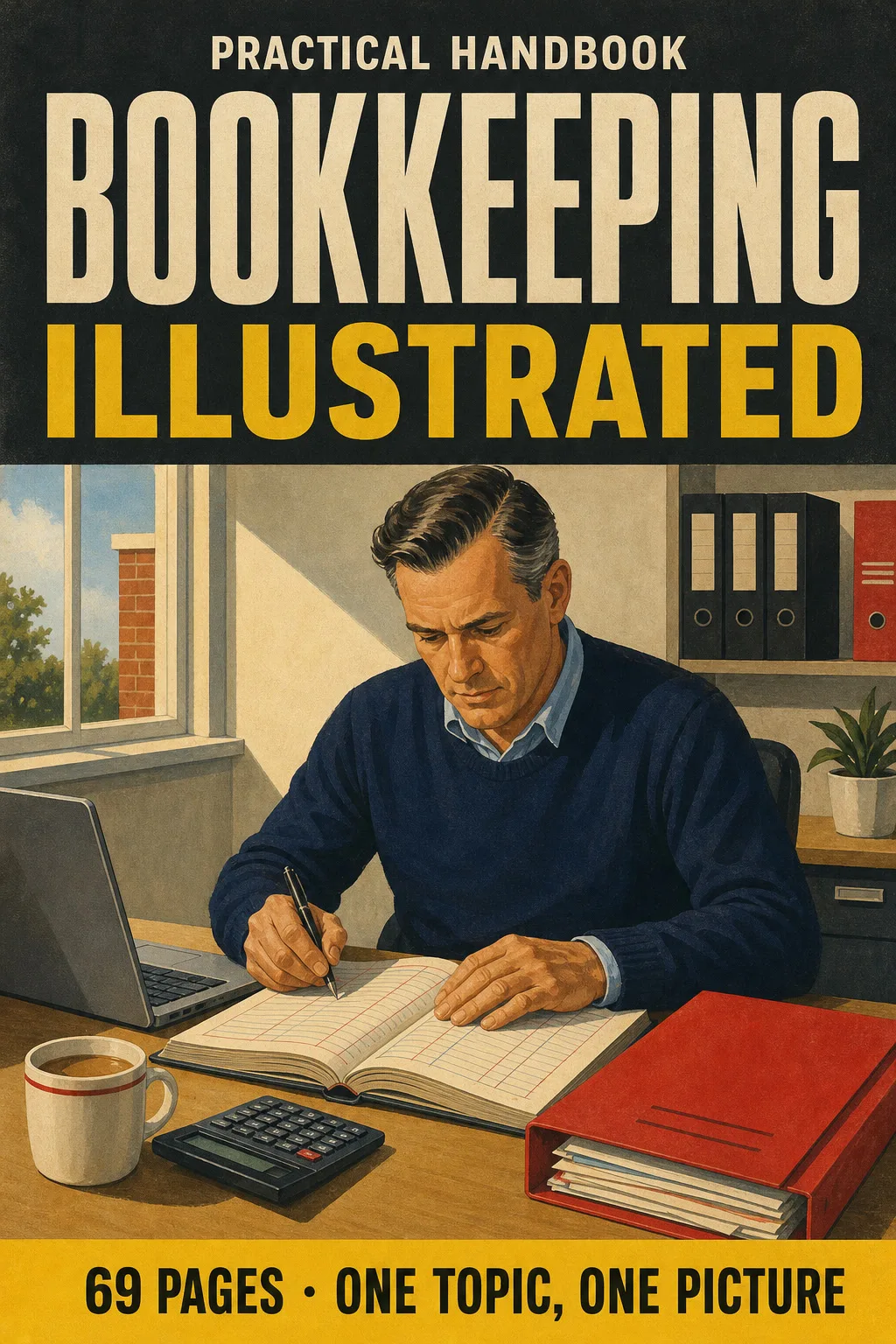
AAT and ICB Bookkeeping, Illustrated: Know Which Side Every Entry Goes One Topic on Every Page

The T account, DEAD CLIC (which side every entry goes), day books, ledgers, the trial balance, VAT, bank reconciliation, accruals and year end. One topic on each page: the drawing first, then what you need to remember. 69 illustrated pages.

START STUDYING THIS WAY

🔒 Secure checkout · PDF by email · 30-day guarantee

Every topic, its own pageDEAD CLIC and the T account drawn, with the explanation alongside
69 illustrated pages9 parts, from the route a bookkeeper always follows to the year-end checklists
Up-to-date sourcesHMRC guidance on GOV.UK, VAT Notice 700 and Making Tax Digital guidance
PDF by emailFormat

Look Inside the Book

Every page has one large drawing and a box with the rules and steps you need to know:

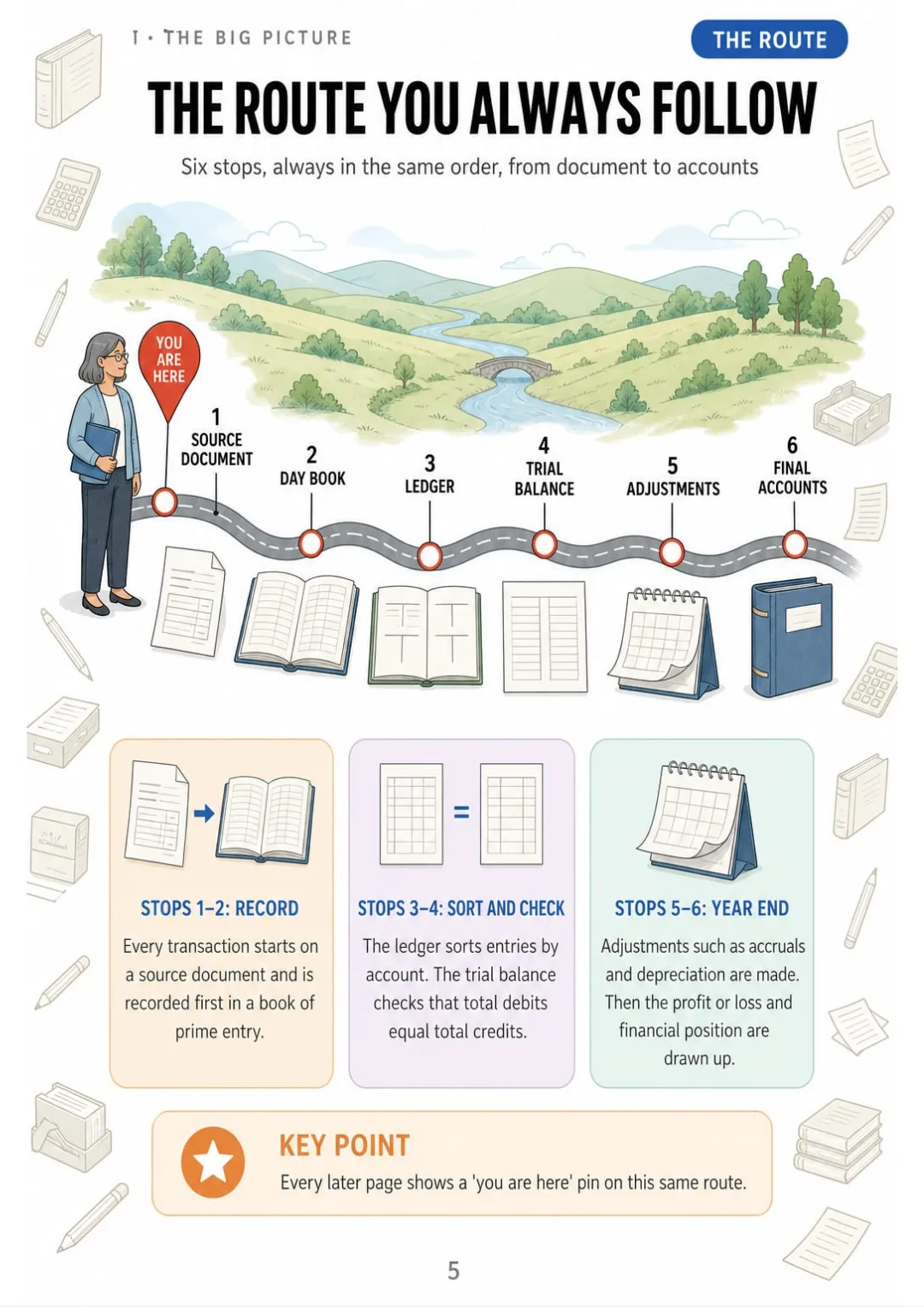
Source document → day book → ledger → trial balance → adjustments → final accounts, drawn as one map.
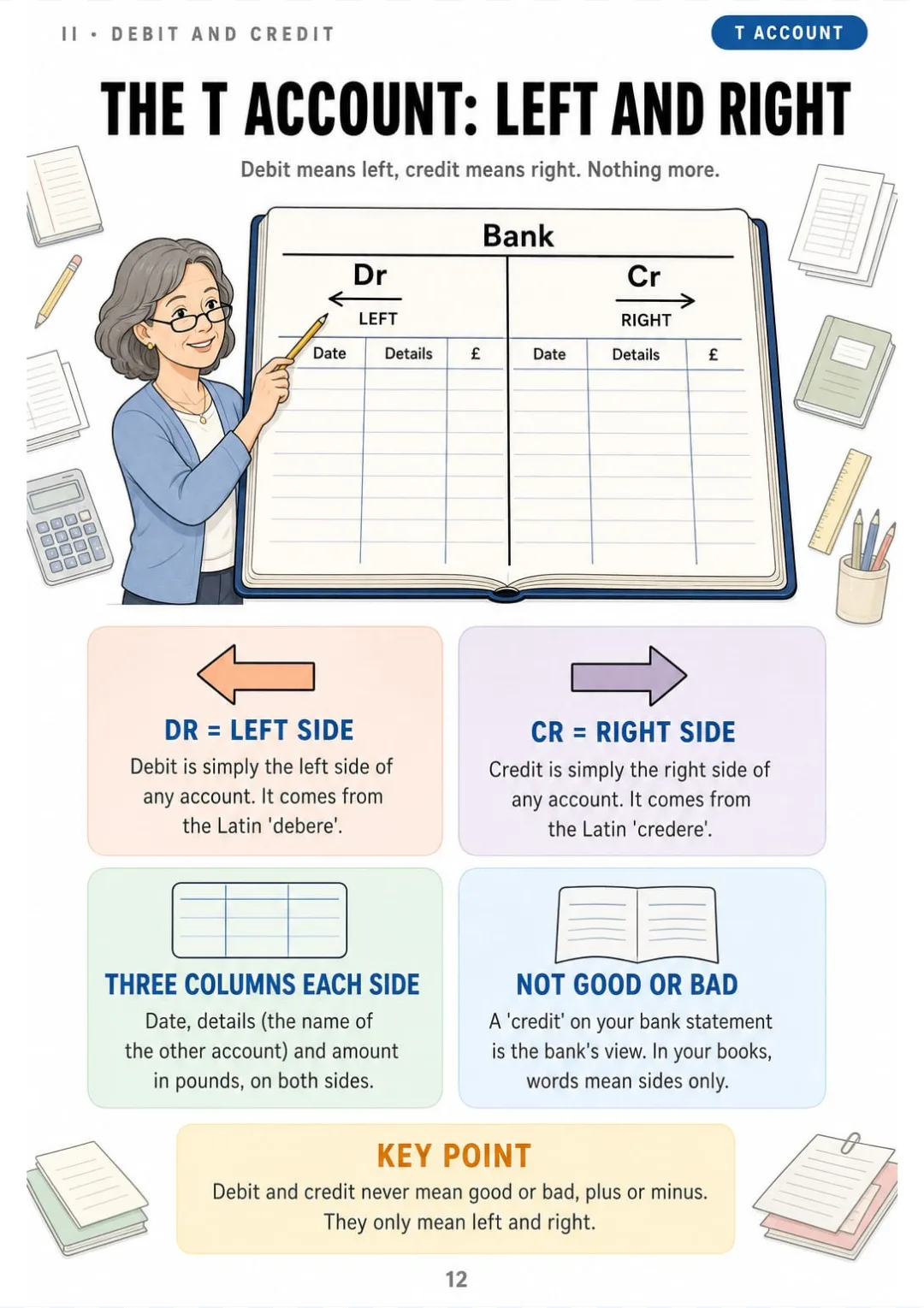
Every account is a T: Dr on the left, Cr on the right, date, details and £ on each side.
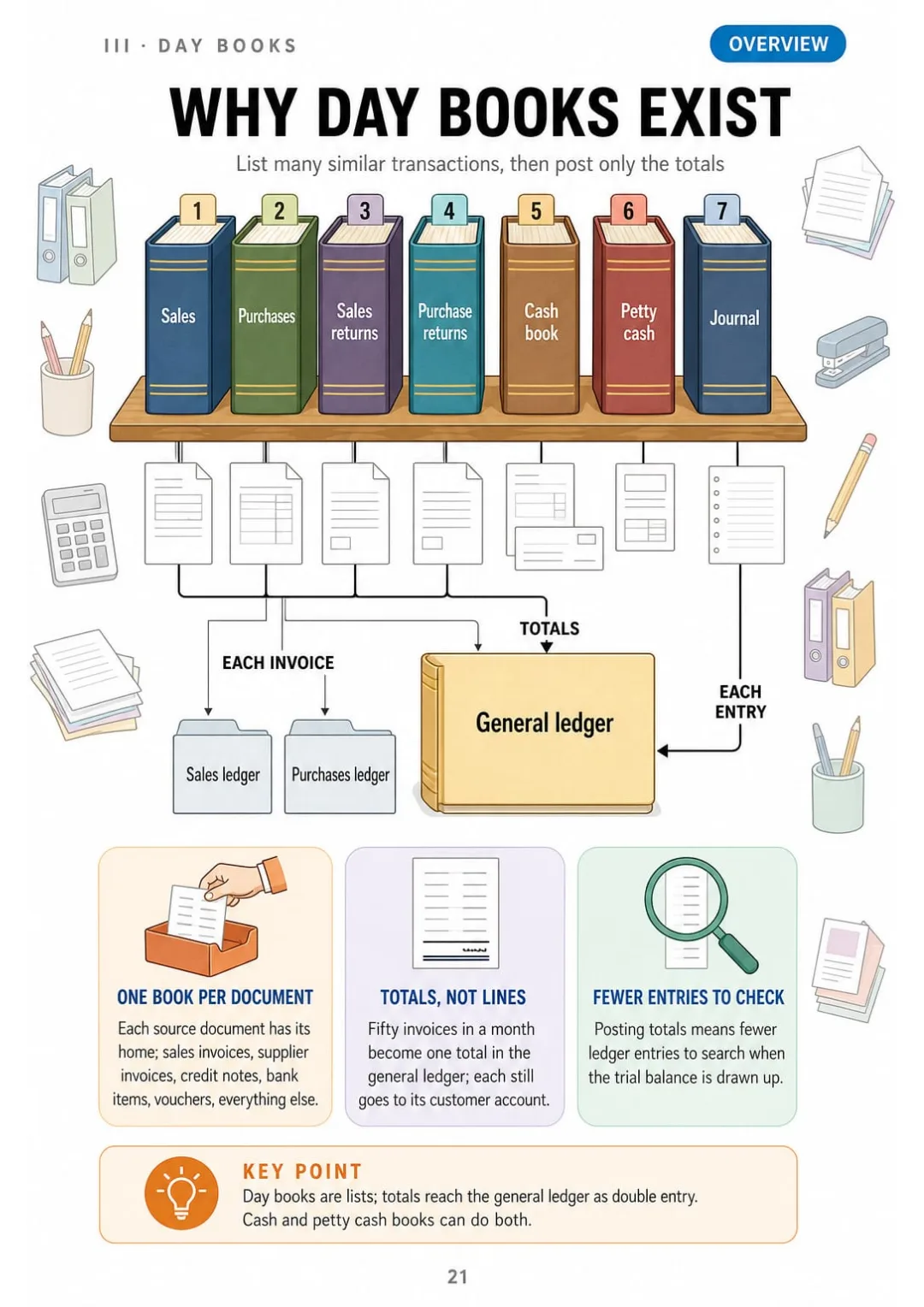
The seven books of prime entry on one shelf, each with its source document
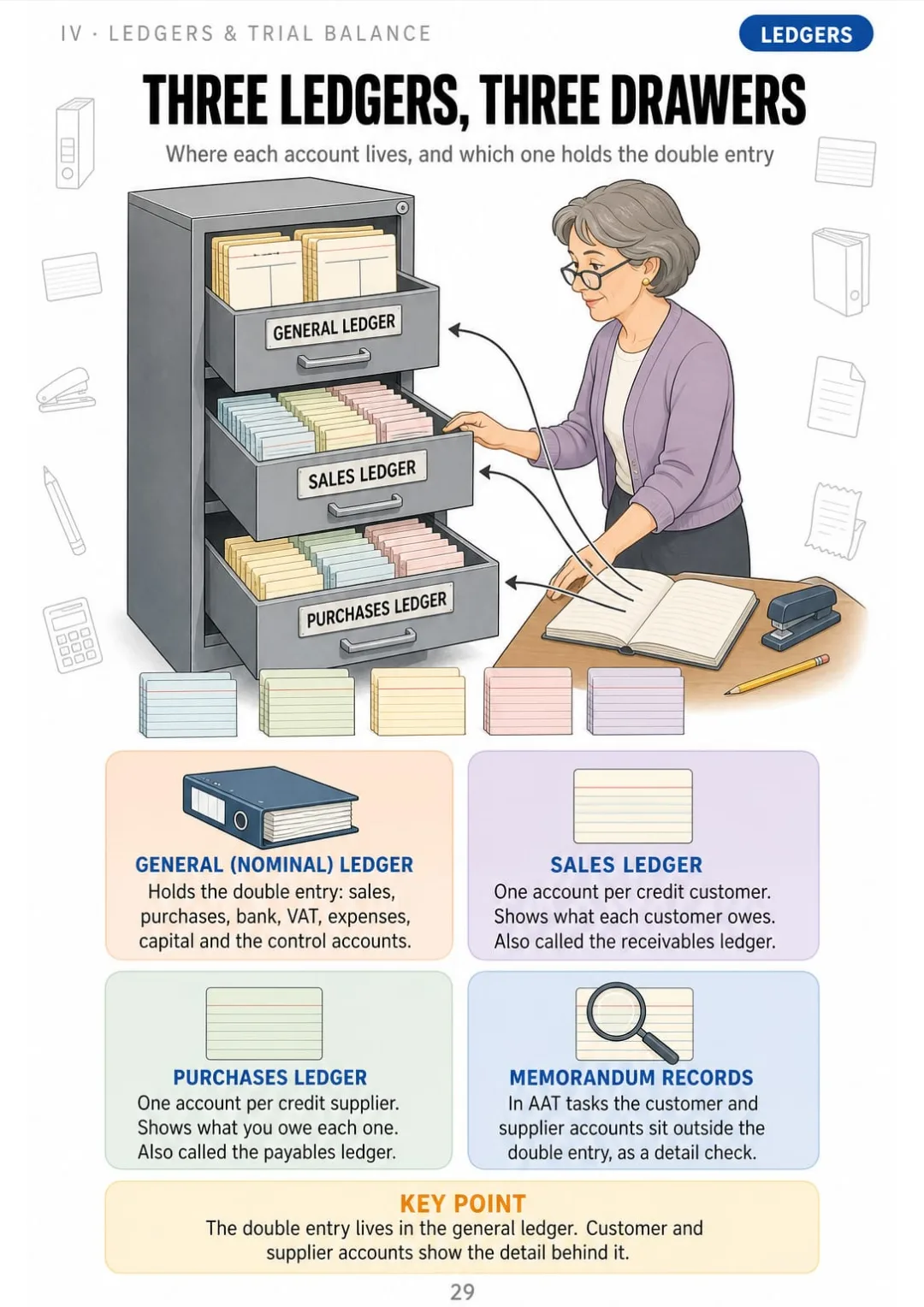
General ledger for the double entry; sales and purchases ledgers for one account per customer and supplier.
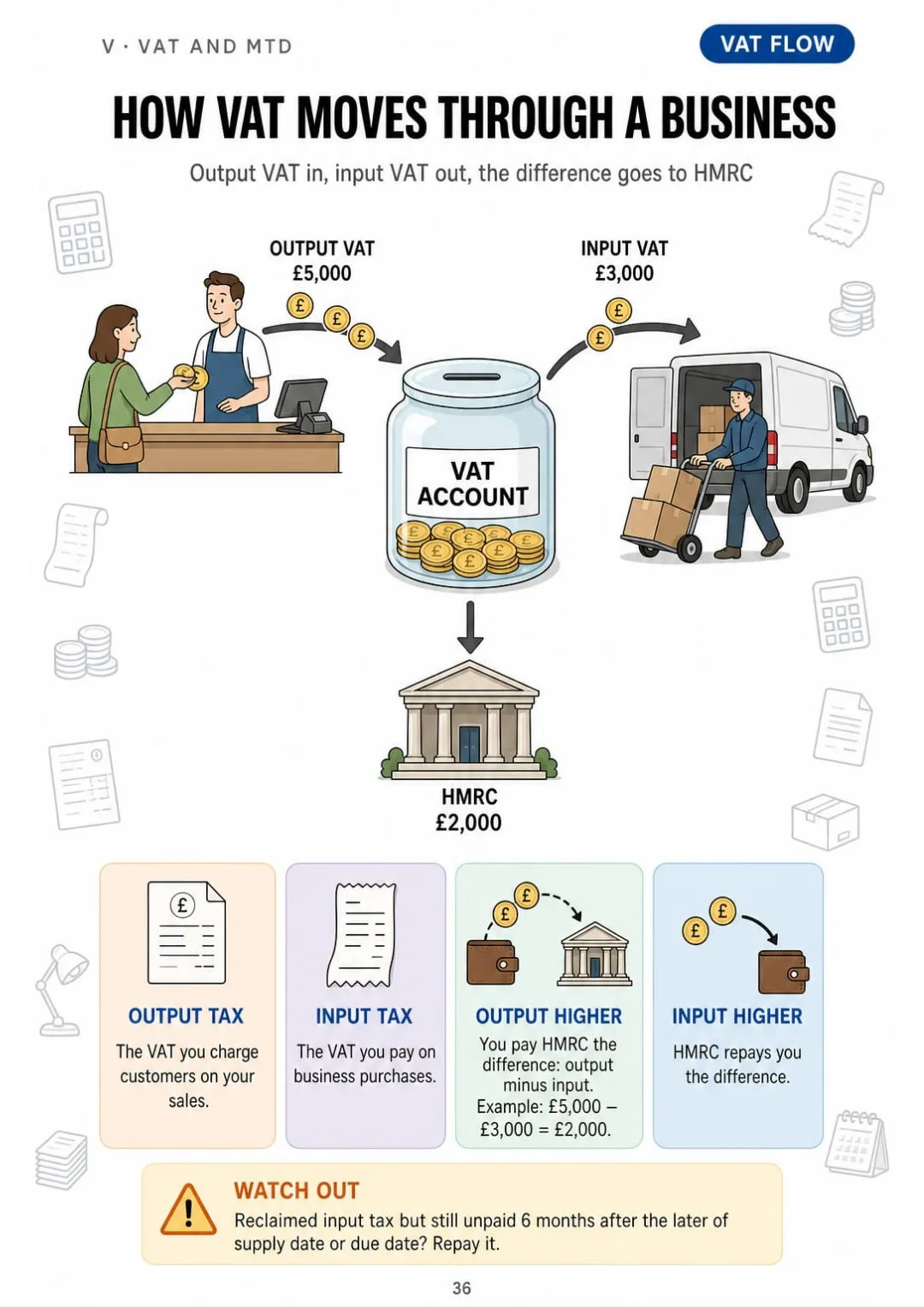
Output VAT minus input VAT: what you pay HMRC, or what HMRC repays you.
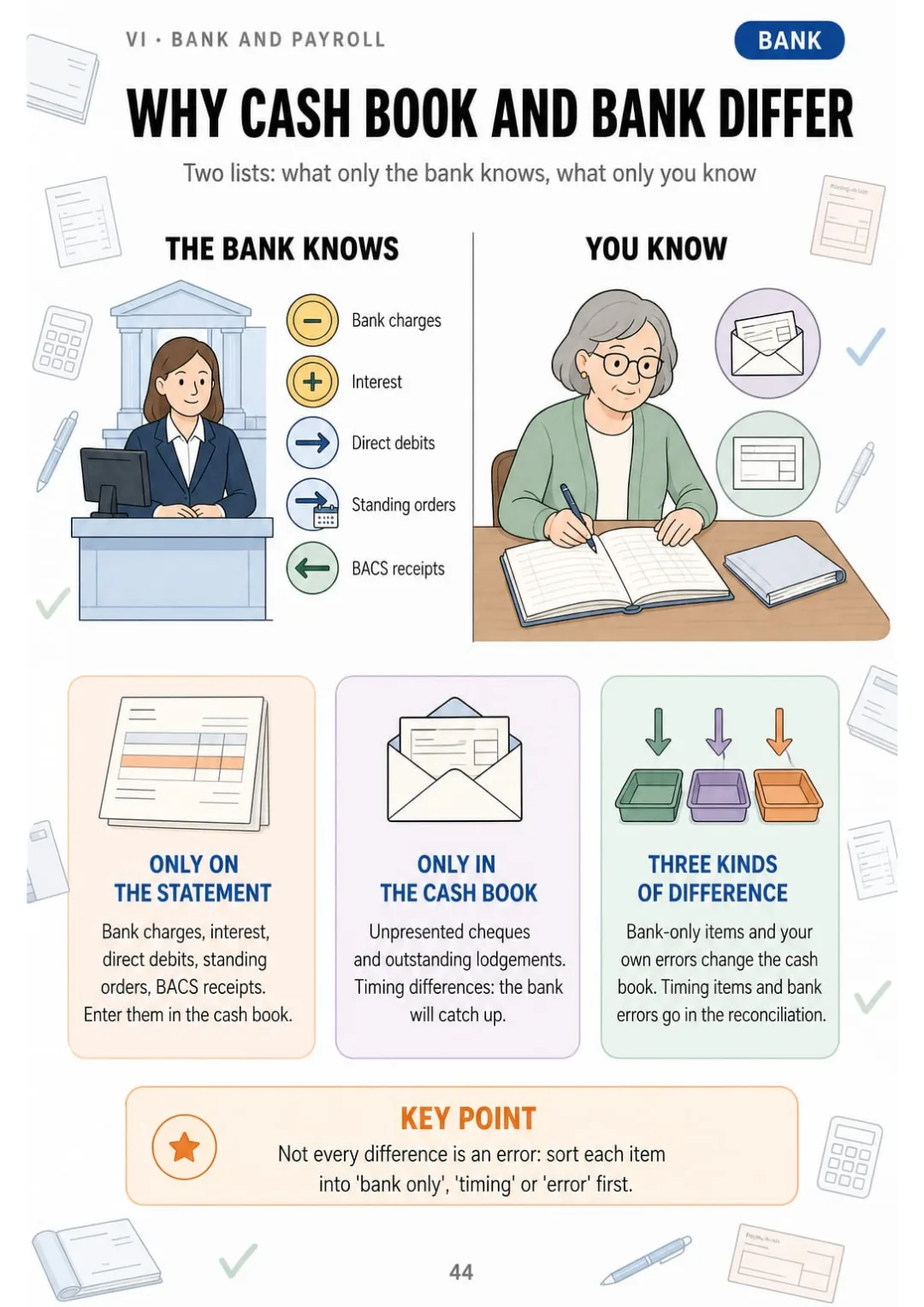
Charges, interest, direct debits vs unpresented cheques and outstanding lodgements
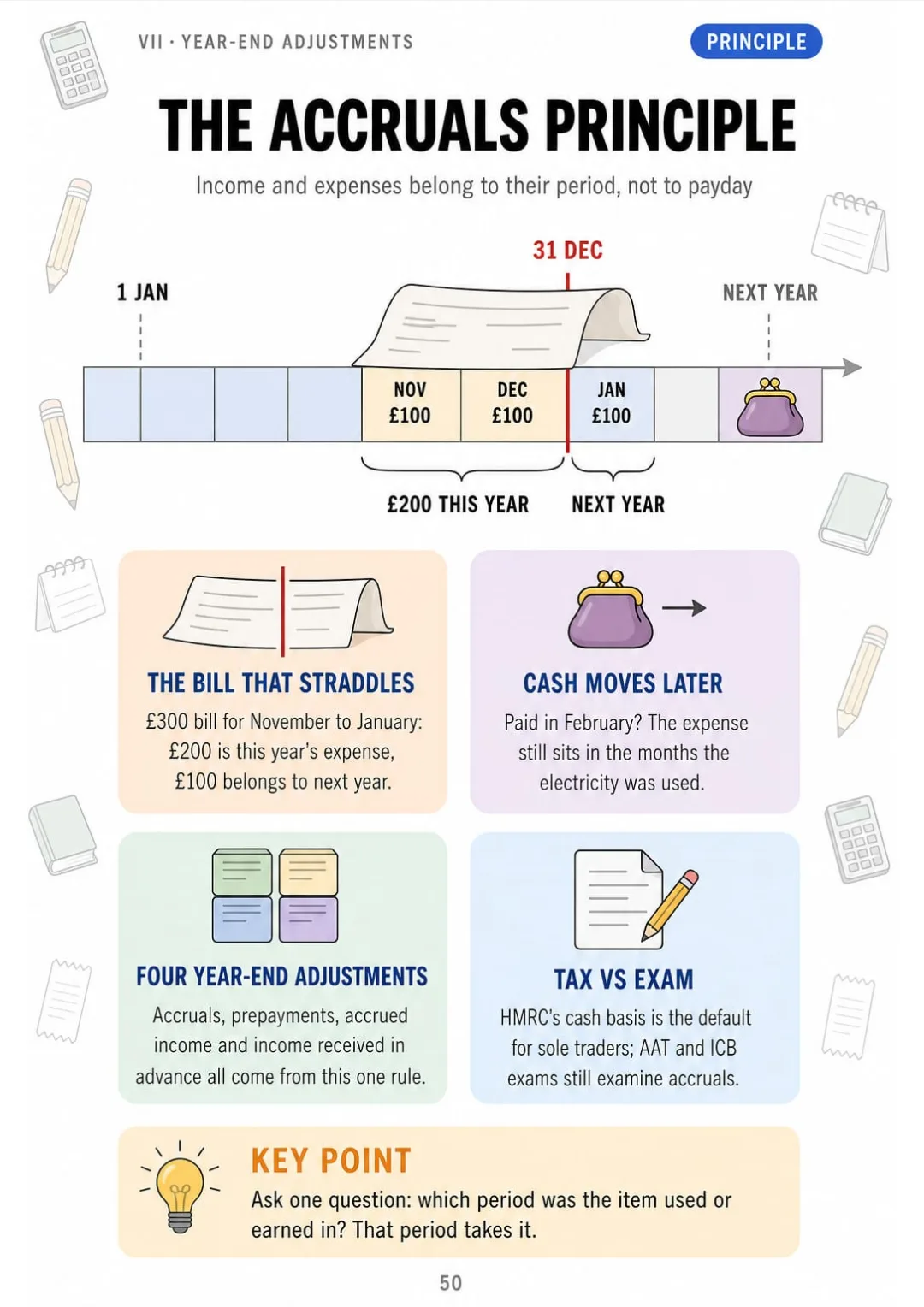
A £300 bill across the year end: £200 this year, £100 next year.
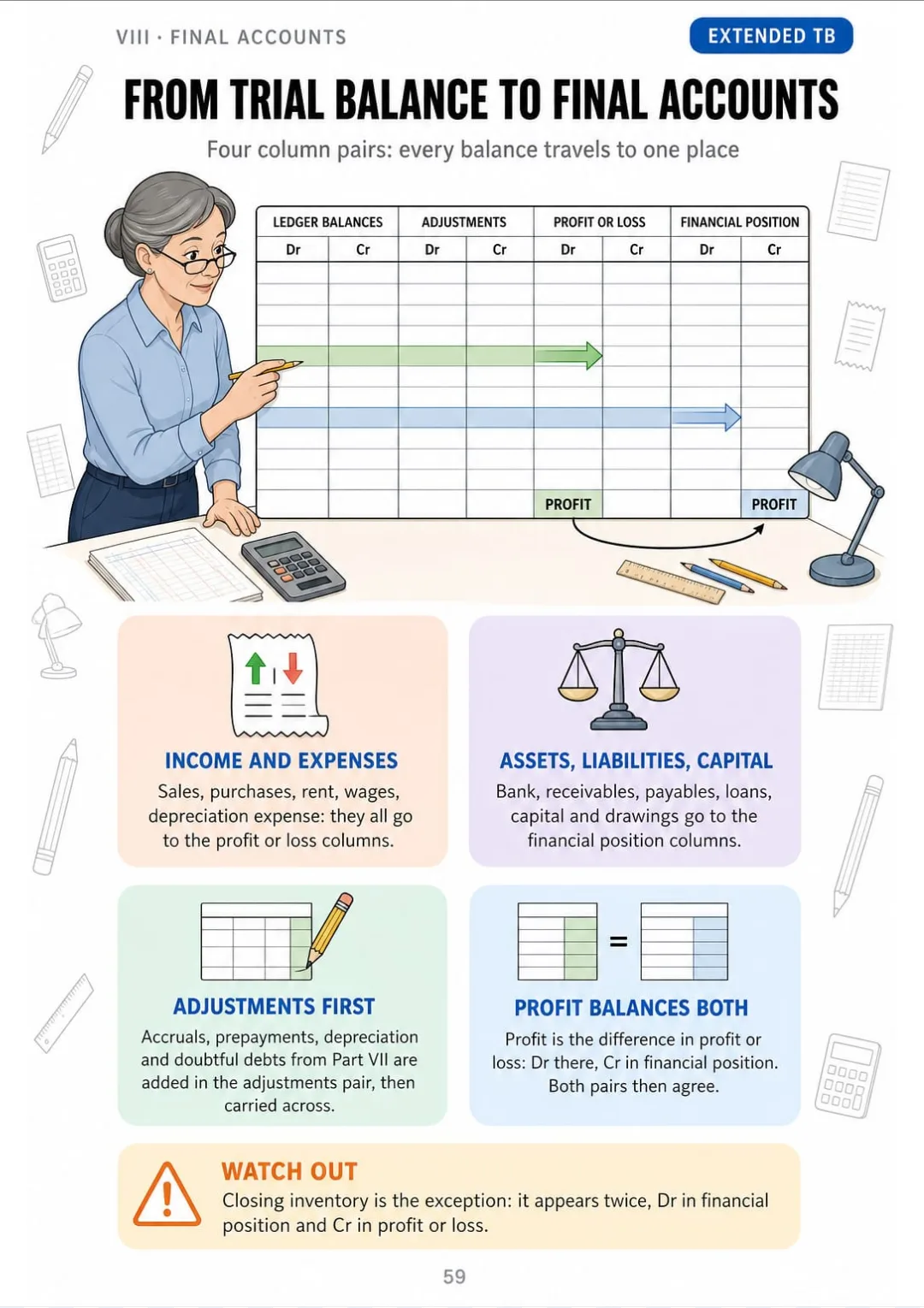
Extended trial balance: ledger, adjustments, profit or loss, financial position, each balance to one column

Swipe to see more →

These are real pages from the book. The table of contents is the full one: 9 parts and 65 topics.

The Problem Isn't You. It's How It Was Explained.

You're sitting with a pile of invoices, credit notes and receipts, and the task asks which book of prime entry each one goes into. You know there are seven, but they all blur into one.

The manual gives you a paragraph per day book, one after another, with no picture of how they sit together. By the third one, the first has gone.

The seven books of prime entry on one shelf, each with its source document

In Bookkeeping Illustrated the same topic is one page: the seven day books on one shelf, each with its source document next to it. Sales invoice, sales day book. Credit note received, purchases returns day book.

The other topics work the same way: the T account, the three ledgers as three drawers, VAT through a business, the bank reconciliation and accruals. Each one has its own page.

So when the next invoice lands on your desk, you know where it goes and you post it without opening the manual again.

COMPARE FOR YOURSELF

The Same Topic, Two Ways to Study It

THIS
  • The manual: line after line
  • Debit and credit explained only in words
  • You go into the exam still unsure
A ledger account is conventionally presented in the form of a T, the left-hand side being designated the debit side and the right-hand side the credit side. Each entry should record the date of the transaction, the details, normally the name of the corresponding account in which the other half of the double entry is posted, and the amount in pounds sterling. Debit entries increase assets and expenses and decrease liabilities, income and capital, whereas credit entries have the opposite effect upon each category.
FOR THIS
  • The T account in one drawing
  • The rules and steps in a box
  • You see it and you get it
Every account is a T: Dr on the left, Cr on the right, date, details and £ on each side.
CONTENTS

Take a Look at the 9 Parts and 65 Topics

The big picture, debit and credit, books of prime entry, ledgers and the trial balance, VAT and Making Tax Digital, the bank and payroll basics, year-end adjustments, final accounts and revision checklists: 69 pages, all illustrated.

IThe Big Picture · pp. 5-11
  1. The Route a Bookkeeper Always Follows
  2. Source Documents: Where Every Entry Starts
  3. Assets, Liabilities and Capital in One Drawing
  4. The Accounting Equation as a Scale
  5. Income and Expenses: What Moves the Scale
  6. Cash vs Credit Transactions
  7. UK Words You Will Meet: Old and New
IIDebit and Credit Without Memorising · pp. 12-20
  1. The T Account: Left Is Debit, Right Is Credit
  2. DEAD CLIC: The One Rule for Which Side
  3. Every Entry Has Two Sides
  4. Recording a Credit Sale
  5. Recording a Credit Purchase
  6. Returns: The Entry Runs Backwards
  7. Drawings: When the Owner Takes Money Out
  8. Capital Expenditure vs Revenue Expenditure
  9. Balancing Off a T Account
IIIBooks of Prime Entry · pp. 21-28
  1. Why Day Books Exist
  2. The Sales Day Book
  3. The Purchases Day Book
  4. The Returns Day Books
  5. The Cash Book: Day Book and Ledger at Once
  6. Discounts in the Cash Book
  7. Petty Cash and the Imprest System
  8. The Journal: For Everything Else
IVLedgers and the Trial Balance · pp. 29-35
  1. General Ledger, Sales Ledger, Purchases Ledger
  2. Control Accounts: One Total for Many Customers
  3. Reconciling the Purchases Ledger Control Account
  4. Building the Trial Balance
  5. Errors the Trial Balance Shows
  6. Errors the Trial Balance Does Not Show
  7. The Suspense Account and Correcting Journals
VVAT and Making Tax Digital · pp. 36-43
  1. How VAT Moves Through a Business
  2. The UK Rates: Standard, Reduced, Zero
  3. Net, VAT and Gross in Three Lines
  4. Posting VAT in the Ledger
  5. Registration: Threshold and Records
  6. The VAT Return, Box by Box
  7. VAT Schemes in One Page
  8. Making Tax Digital for VAT and Income Tax
VIThe Bank and Payroll Basics · pp. 44-49
  1. Why the Cash Book and the Bank Never Match
  2. Bank Reconciliation in 5 Steps
  3. Overdrafts and Debit/Credit on the Statement
  4. Payroll Entries Without the Jargon
  5. Recurring Payments: Standing Orders and Direct Debits
  6. Keeping Records: What and How Long
VIIYear-End Adjustments · pp. 50-58
  1. The Accruals Principle in One Drawing
  2. Accruals: Expenses Owed at Year End
  3. Prepayments: Paid in Advance
  4. Accrued and Prepaid Income
  5. Depreciation: Straight Line
  6. Depreciation: Reducing Balance
  7. Disposing of a Non-Current Asset
  8. Irrecoverable Debts and the Allowance for Doubtful Debts
  9. Closing Inventory
VIIIFinal Accounts · pp. 59-63
  1. From Trial Balance to Final Accounts
  2. Cost of Sales and Gross Profit
  3. The Statement of Profit or Loss
  4. The Statement of Financial Position
  5. Sole Trader, Partnership, Limited Company: What Changes
IXRevision and Checklists · pp. 64-69
  1. DEAD CLIC Cheat Sheet
  2. Which Entry? 20 Transactions at a Glance
  3. Trial Balance Won't Balance: Search Checklist
  4. Bank Reconciliation and Control Account Checklists
  5. Year-End Checklist
  6. Frequent Mistakes Drawn Side by Side

One Page, One Topic, All Clear

Think of it this way:

It's the last week before your AAT exam, or the end of the month at work, and you need a bank reconciliation that agrees with the statement.

You open the page on why the cash book and the bank differ and see it drawn: bank charges, interest and direct debits on one side, unpresented cheques and outstanding lodgements on the other.

Output VAT minus input VAT: what you pay HMRC, or what HMRC repays you.

The same goes for DEAD CLIC, the sales day book, control accounts, the VAT return box by box and depreciation: each one on its own page, in the order a bookkeeper works.

Bookkeeping Illustrated is 9 parts and 69 illustrated pages, one topic on each, ending with checklists for the trial balance, the bank and year end.

What you see drawn, you don't have to memorize.

What's Inside Bookkeeping Illustrated:

Ipp. 5-11

The Big Picture

The route a bookkeeper follows, source documents, assets, liabilities and capital, the accounting equation as a scale, income and expenses, cash vs credit, and UK terms old and new.

IIpp. 12-20

Debit and Credit Without Memorising

Know which side every entry goes. The T account, DEAD CLIC, the two sides of every entry, credit sales and purchases, returns, drawings, capital vs revenue expenditure and balancing off.

IIIpp. 21-28

Books of Prime Entry

Why day books exist, the sales, purchases and returns day books, the cash book, discounts, petty cash with the imprest system and the journal.

IVpp. 29-35

Ledgers and the Trial Balance

Find out why a trial balance won't agree. The three ledgers, control accounts, reconciling the purchases ledger control account, building the trial balance, the errors it shows and the ones it doesn't, and the suspense account.

Vpp. 36-43

VAT and Making Tax Digital

Do a VAT return without guessing. How VAT moves, the 20% standard, 5% reduced and zero rates, net, VAT and gross, posting VAT, registration, the VAT return box by box, VAT schemes and Making Tax Digital.

VIpp. 44-49

The Bank and Payroll Basics

Why the cash book and the bank differ, bank reconciliation in 5 steps, overdrafts, payroll entries, standing orders and direct debits, and how long to keep records.

VIIpp. 50-58

Year-End Adjustments

The accruals principle, accruals and prepayments, accrued and prepaid income, straight-line and reducing-balance depreciation, disposals, irrecoverable debts and closing inventory.

VIIIpp. 59-63

Final Accounts

From trial balance to final accounts, cost of sales and gross profit, the statement of profit or loss, the statement of financial position and what changes by type of business.

IXpp. 64-69

Revision and Checklists

The DEAD CLIC cheat sheet, 20 transactions at a glance, checklists for the trial balance, the bank, control accounts and year end, and frequent mistakes side by side.

At the end of the book: Revision checklists, a DEAD CLIC cheat sheet and 20 transactions at a glance.
Plus: 2 Free Books

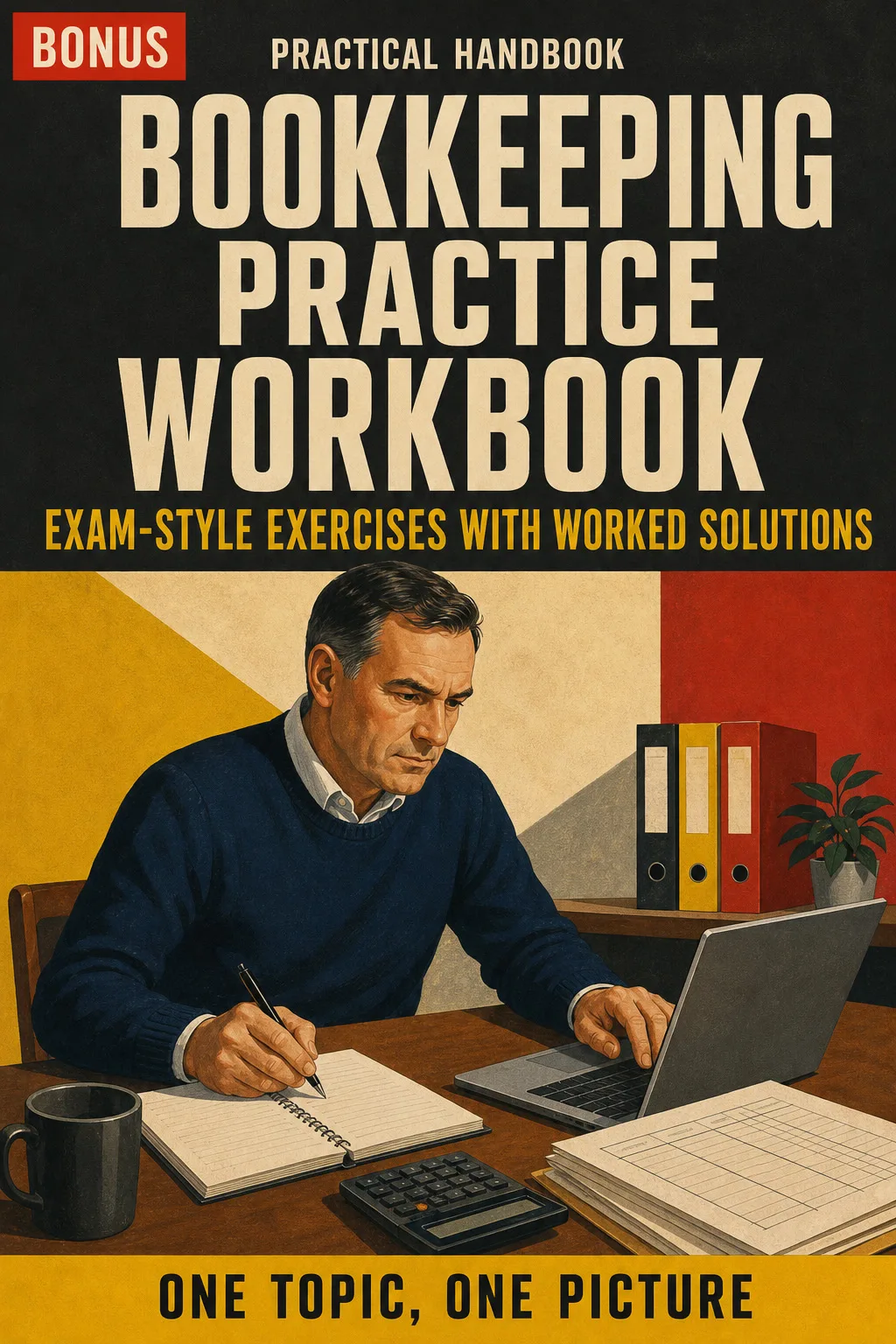
Bookkeeping Practice Workbook: Exam-Style Exercises with Worked Solutions

BONUS 1: «Bookkeeping Practice Workbook: Exam-Style Exercises with Worked Solutions»

Value on its own: US$ 17.90

Practise every topic with exam-style tasks, from T accounts to the trial balance, and check each answer against a worked solution, line by line.

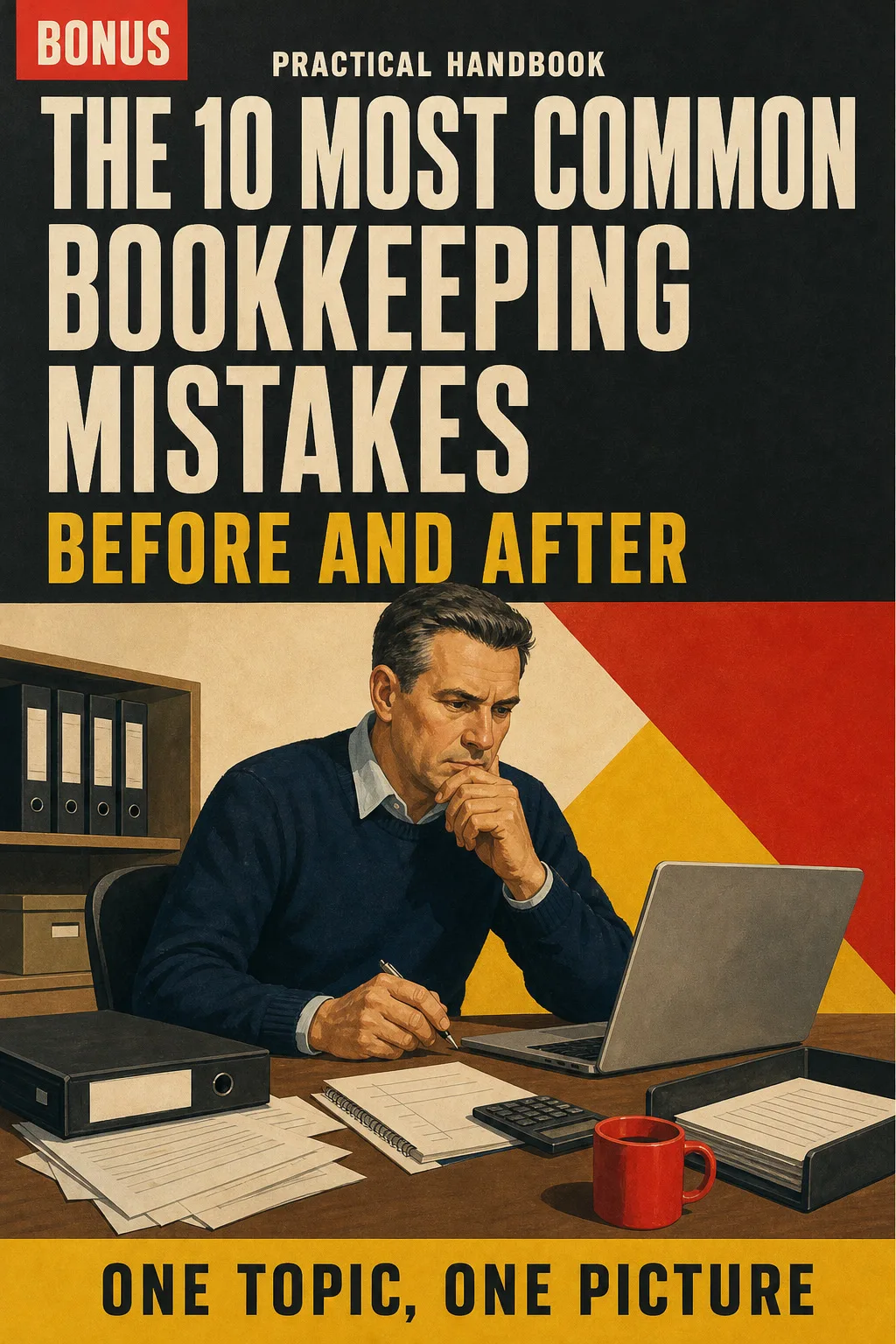
The 10 Most Common Bookkeeping Mistakes: Before and After

BONUS 2: «The 10 Most Common Bookkeeping Mistakes: Before and After»

Value on its own: US$ 14.90

See the mistakes beginners make most often (wrong side, missed VAT, double posting) drawn side by side with the correct entry, so you spot them before they reach your trial balance.

Bookkeeping Illustrated with 2 Free Books

  • Bookkeeping Illustrated: 69 illustrated pagesUS$ 63
  • BONUS 1: Bookkeeping Practice Workbook: Exam-Style Exercises with Worked SolutionsUS$ 17.90
  • BONUS 2: The 10 Most Common Bookkeeping Mistakes: Before and AfterUS$ 14.90
  • High-resolution PDF to printIncluded
Total value US$ 95.80
YOUR PRICE:
US$ 27
You save US$ 68.80
YES, I WANT BOOKKEEPING ILLUSTRATED FOR US$ 27

📄 This is a digital PDF book sent to your email: nothing is printed or shipped.

Secure purchaseEncrypted payment30-day guarantee

PDF by email: We email you Bookkeeping Illustrated as a PDF, together with the two free books. It's a single payment: no installments, no extra charges.

Who This Book Is For

You're studying AAT or ICB

You're studying AAT or ICB

Each topic is one drawn page, so debit and credit, day books and ledgers follow one route you can see. You revise in the evening and it's still there in the morning.

Your exam is coming up

Your exam is coming up

The checklists for the trial balance, the bank reconciliation and year end put the steps in the same order every time, and the workbook lets you practise with worked solutions.

You already keep the books

You already keep the books

As a sole trader or the person doing the office accounts, you get VAT, the bank and year-end adjustments on one page each, ready to print and keep on the desk.

Everything You Get Today

US$ 95.80US$ 27
YES, I WANT BOOKKEEPING ILLUSTRATED FOR US$ 27

📄 This is a digital PDF book sent to your email: nothing is printed or shipped.

30DAYS
GUARANTEE

30-Day Guarantee

Try Bookkeeping Illustrated for 30 days, bonus books included.

We refund everything if the file won't open, if the book isn't what you see here, if you were charged twice or if the email doesn't arrive. Just email us.

You pay once. No subscriptions.

Frequently Asked Questions

Is it for me if I'm studying AAT or ICB, or doing my own books?

Yes. It starts from the route and the T account, so you can begin from scratch, and covers the bookkeeping in AAT Level 2 and ICB Level 2: day books, ledgers, control accounts, the trial balance, VAT and the bank reconciliation. Adjustments and final accounts help when you move on to Level 3. UK terms throughout, not American ones.

Where does the content come from?

UK bookkeeping practice and terminology as used in the AAT and ICB qualifications, in pounds and with UK terms. VAT rates, registration, the VAT return and Making Tax Digital are checked against HMRC guidance on GOV.UK, including VAT Notice 700. HMRC can change rates and thresholds, so GOV.UK is always the place to confirm the current figure.

Is it official material?

No. It's an independent illustrated study book. It isn't published, endorsed or approved by AAT, ICB or HMRC, and it doesn't give you a certificate or count towards your qualification.

Does it replace my course?

No. It's for studying and revising alongside your course, and it doesn't replace an accountant's advice for your own business.

Are the practice questions the ones from the exam?

No. The exercises in the workbook are written for this book, in an exam style, with worked solutions. They aren't official exam questions.

When and how does it arrive?

The book and the 2 bonus books arrive as PDFs by email, at the address you enter when you pay.

Do I have to pay every month?

No. It's a one-off payment, with no subscription.

Can I have it on paper?

Yes. The PDF is made to print, at home or at a print shop, in full or just the pages you need.

How does the refund work?

You have 30 days. We refund everything if the file won't open, if the book isn't what you see on this page, if you were charged twice or if the email doesn't arrive: just email us.

Before You Close This Page

No more rereading with nothing sticking.

Debit and credit, drawn on the page, so they stay put.

You walk into the exam or the year end knowing where everything is.

Drawings make studying faster.

The book is right below.

One-time payment: US$ 27 · Guarantee: 30 days · PDF by email

YES, I WANT BOOKKEEPING ILLUSTRATED FOR US$ 27

📄 This is a digital PDF book sent to your email: nothing is printed or shipped.